Discover how essential protein is for building muscle, how much you really need, and smart strategies for timing and quality. Build stronger, recover faster with WARDOG’s expert insights.
Introduction
Walk into any gym, scroll through any fitness influencer’s feed, or browse bodybuilding forums, and you’ll notice one common obsession: protein. Pre-workout shakes, post-workout chicken breasts, bedtime casein, the fitness community’s devotion to protein borders on religious. But is this fixation justified, or is it just bro-science run amok?
Here’s the reality: protein isn’t just important for muscle building, it’s absolutely fundamental. Without adequate protein intake combined with proper resistance training, your muscle-building goals will remain frustratingly out of reach. However, the story doesn’t end with simply “eating more protein.” The quality of your protein sources, when you consume them, and how you distribute intake throughout the day all play crucial roles in maximizing your gains.
Many lifters misunderstand the nuances of protein consumption. They either under-eat, thinking food alone will suffice without tracking, or they over-consume, believing that downing endless protein shakes will somehow compensate for inconsistent training. The truth lies somewhere in between, grounded in research and practical application.
In this comprehensive guide, Wardog breaks down the real science behind protein and muscle growth. You’ll learn exactly how much protein you need, which sources deliver the best results, when to consume it for optimal gains, and how to avoid common pitfalls that derail progress. Whether you’re a beginner lifter or someone looking to fine-tune your nutrition strategy, this evidence-based approach will help you build muscle more effectively.
What Is Protein & Why Does It Matter for Muscle?
Before diving into recommendations, let’s establish what protein actually is and why it’s indispensable for muscle development.
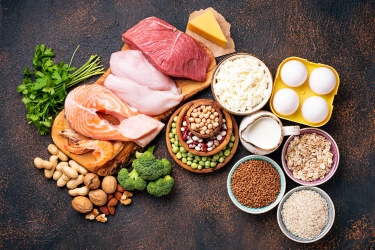
Protein is one of three macronutrients (alongside carbohydrates and fats) and serves as the primary building block of muscle tissue. When you consume protein, your digestive system breaks it down into amino acids, smaller compounds that your body uses for various functions, including tissue repair, enzyme production, and hormone synthesis.
There are 20 different amino acids, nine of which are considered “essential” because your body cannot produce them on its own. You must obtain these essential amino acids through diet. The remaining amino acids are “non-essential,” meaning your body can synthesize them from other compounds.
The Role of Amino Acids in Muscle Repair and Building
When you lift weights or engage in resistance training, you create microscopic tears in your muscle fibers. This might sound alarming, but it’s actually the foundation of muscle growth. Your body responds to this damage by repairing and reinforcing the affected fibers, making them larger and stronger, a process called muscle hypertrophy.
This repair and growth process requires amino acids. Specifically, your muscles need adequate supplies of essential amino acids to synthesize new muscle proteins. Without sufficient amino acids available, your body cannot effectively rebuild damaged tissue or add new muscle mass, regardless of how hard you train.
Understanding Muscle Protein Turnover
Your muscles exist in a constant state of flux through a process called muscle protein turnover. At any given moment, your body is simultaneously breaking down old or damaged muscle proteins (muscle protein breakdown, or MPB) and building new ones (muscle protein synthesis, or MPS).
To build muscle, the rate of muscle protein synthesis must exceed the rate of muscle protein breakdown. This creates a positive net protein balance, resulting in muscle growth over time. Consuming adequate protein, particularly after training, tips the scales toward synthesis and away from excessive breakdown.
The concept of nitrogen balance further illustrates this principle. Since protein contains nitrogen (unlike carbs and fats), measuring nitrogen intake versus nitrogen excretion provides insight into whether your body is in an anabolic (muscle-building) or catabolic (muscle-wasting) state. A positive nitrogen balance, taking in more nitrogen than you excrete, indicates you’re providing enough protein for muscle maintenance and growth.
Start Your Muscle-Building Journey with WARDOG
How Much Protein Do You Actually Need?
This is the million-dollar question, and the answer depends on your goals and activity level.
The Baseline vs. Optimal Intake
The Recommended Dietary Allowance (RDA) for protein is 0.8 grams per kilogram of body weight (0.36 grams per pound) per day. This baseline recommendation is designed to prevent deficiency in sedentary individuals, not to optimize muscle growth in active lifters.
For people engaged in regular resistance training with muscle-building goals, research consistently shows that protein requirements are significantly higher. Multiple studies suggest that lifters should consume between 1.6 to 2.2 grams of protein per kilogram of body weight daily (roughly 0.7 to 1.0 grams per pound).
This higher range ensures you’re providing adequate raw materials for muscle protein synthesis, especially during the critical recovery periods following training sessions. For a 180-pound (82 kg) lifter, this translates to approximately 130 to 180 grams of protein per day.
Individual Factors to Consider
Several factors can influence your personal protein needs:
- Training intensity and volume: Harder, more frequent training increases protein requirements
- Caloric deficit: When cutting weight, higher protein intake (up to 2.2 g/kg) helps preserve muscle mass
- Training experience: Beginners may build muscle with slightly lower protein intake than advanced lifters
- Age: Older lifters may benefit from higher protein consumption to combat age-related muscle loss
Diminishing Returns and Upper Limits
Can you eat too much protein? While extremely high protein intakes aren’t necessarily harmful for healthy individuals, there are practical diminishing returns. Research suggests that consuming more than 2.2 g/kg daily provides minimal additional benefit for muscle growth. Beyond this threshold, the extra protein is simply used for energy or converted to other compounds, rather than contributing meaningfully to muscle synthesis.
That said, protein has a higher thermic effect than other macronutrients (meaning your body burns more calories digesting it) and tends to increase satiety, which can be beneficial during fat loss phases.
Protein Quality & Sources Matter
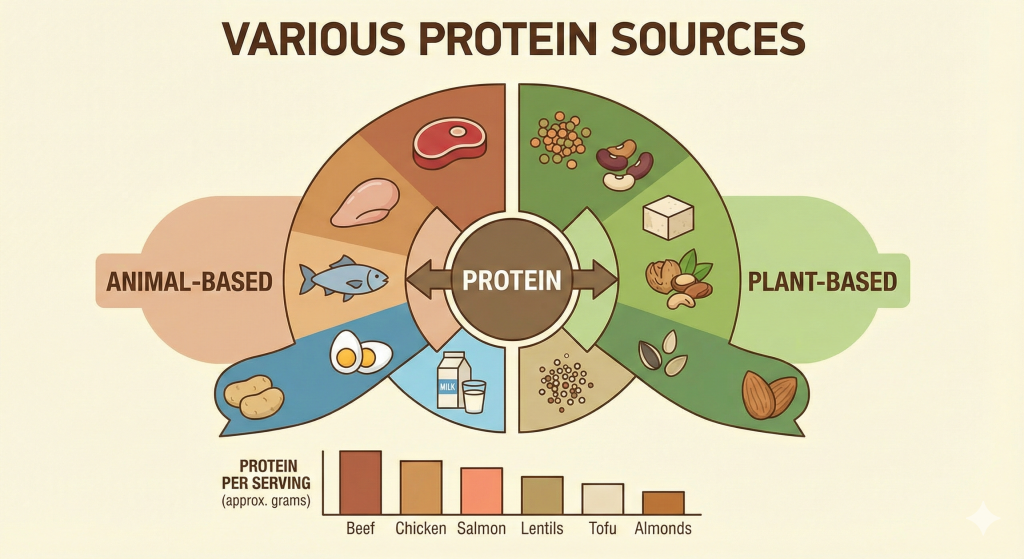
Not all protein sources are created equal. The quality of your protein intake significantly impacts how effectively your body can use it for muscle building.
Complete vs. Incomplete Proteins
Complete proteins contain all nine essential amino acids in adequate proportions. Animal-based sources like meat, poultry, fish, eggs, and dairy are complete proteins. Most plant-based proteins are incomplete, lacking one or more essential amino acids, though there are exceptions like quinoa and soy.
For lifters relying primarily on plant-based protein, combining complementary sources (like rice and beans) throughout the day ensures you’re getting all essential amino acids. However, you may need to consume slightly more total protein from plant sources to achieve the same muscle-building effect as animal proteins.
The Leucine Threshold and BCAAs
Among the essential amino acids, leucine deserves special attention. This branched-chain amino acid (BCAA) acts as a key trigger for muscle protein synthesis. Research indicates that consuming approximately 2-3 grams of leucine per meal maximally stimulates the muscle-building process.
High-quality protein sources, particularly whey protein, are rich in leucine. This is one reason why whey has earned its reputation as an optimal post-workout protein source, it’s rapidly digested and delivers a powerful leucine punch to kickstart recovery.
Protein Biological Value and Digestion Rates
Biological value (BV) measures how efficiently your body can use a protein source. Proteins with high BV, like eggs and whey, are absorbed and utilized more effectively than lower-BV sources.
Digestion rates also matter for strategic protein timing:
- Fast-digesting proteins (whey, egg whites): Rapidly increase amino acid availability, ideal post-workout
- Slow-digesting proteins (casein, whole food proteins): Provide sustained amino acid release, beneficial before bed or between meals
A balanced approach incorporating both fast and slow proteins throughout the day supports continuous muscle protein synthesis.
Timing: When to Eat Protein
While total daily protein intake remains the most important factor, strategic timing can provide additional benefits for muscle growth and recovery.
The Anabolic Window
You’ve probably heard about the “anabolic window”, the supposed narrow post-workout period when you must consume protein for optimal gains. While early research suggested this window was only 30-60 minutes wide, newer evidence paints a more nuanced picture.
The muscle protein synthesis response to training remains elevated for 24-48 hours after your workout, not just immediately afterward. That said, consuming protein within a few hours of training, particularly if you trained fasted, can enhance recovery and muscle building.
The practical takeaway: Don’t stress about chugging a shake within 30 minutes of finishing your last set, but do aim to have a protein-rich meal within a few hours of training.
Protein Distribution Throughout the Day
Rather than consuming most of your protein in one or two large meals, research supports distributing protein relatively evenly across three to five meals throughout the day. This approach maintains elevated muscle protein synthesis for longer periods.
Aim for 20-40 grams of high-quality protein per meal, with each serving containing enough leucine (2-3 grams) to trigger the muscle-building response. This distribution strategy outperforms consuming the same total protein in just one or two meals.
Protein Before Bed
Consuming 30-40 grams of slow-digesting protein (like casein or a whole-food protein source) before bed can support overnight muscle recovery and growth. Since you’re fasting during sleep, this pre-bed protein provides a sustained release of amino acids during the overnight hours when your body is repairing and rebuilding muscle tissue.
Protein + Training: Why It’s a Package Deal
Here’s a critical truth that many people miss: protein doesn’t build muscle by itself, resistance training does. Protein supports and amplifies the muscle-building response to training, but it cannot create that response in the absence of an appropriate training stimulus.
Resistance Training Stimulates Growth
When you lift weights, especially with progressive overload (gradually increasing weight, reps, or volume), you signal to your body that your current muscle mass is insufficient for the demands you’re placing on it. This mechanical tension, along with metabolic stress and muscle damage, triggers the adaptive process that leads to hypertrophy.
Protein Amplifies the Adaptive Response
Once you’ve created that training stimulus, adequate protein intake ensures your body has the raw materials needed to execute the adaptation. Research demonstrates that resistance training combined with sufficient protein intake produces significantly greater muscle growth than either intervention alone.
Conversely, consuming high amounts of protein without training won’t stimulate meaningful muscle growth. Your body has no reason to build new muscle tissue if you’re not creating a demand for increased strength and size through progressive resistance training.
This synergy between training and nutrition is why successful muscle building requires attention to both factors. You can’t out-supplement or out-eat a poor training program, and you can’t fully capitalize on great training without proper nutritional support.
Common Myths & Misconceptions
Let’s address some persistent myths about protein and muscle building:
Myth 1: “More Protein Always Equals More Muscle”
While adequate protein is essential, there’s a ceiling to its benefits. Consuming 300 grams of protein daily won’t build more muscle than consuming the optimal amount for your body weight and training status. Once you’ve met your body’s needs (roughly 1.6-2.2 g/kg), additional protein provides minimal added benefit for muscle growth.
Focus on hitting your target consistently rather than excessively overshooting it.
Myth 2: “High Protein Damages Your Kidneys”
This concern stems from the fact that people with pre-existing kidney disease must limit protein intake. However, research has not shown that high protein consumption damages healthy kidneys. If you have normal kidney function, consuming the protein amounts recommended for muscle building poses no kidney risk.
That said, staying well-hydrated is always important, especially with higher protein intakes.
Myth 3: “I Don’t Need Supplements, I Get Enough from Food”
This isn’t necessarily a myth, but rather a case-by-case situation. It’s absolutely possible to meet your protein needs through whole food sources alone. However, supplements like whey protein offer convenience, rapid digestion, and cost-effectiveness that make hitting your daily target easier.
Supplements are supplementary, they fill gaps when whole foods are inconvenient or insufficient. They’re tools, not mandatory magic potions. If you consistently hit your protein target through food and your training is progressing well, supplements aren’t required. But for most busy lifters, having a quality protein powder on hand makes consistent nutrition significantly more manageable.
How to Apply This: Practical Tips
Understanding the science is valuable, but application is where results happen. Here’s how to put this knowledge into practice:
Calculate Your Personal Protein Target
Step 1: Convert your body weight to kilograms (divide pounds by 2.2) Step 2: Multiply by 1.6-2.2 to find your daily protein range in grams
Example: A 180-pound lifter:
- 180 ÷ 2.2 = 82 kg
- 82 × 1.6 = 131 grams (lower end)
- 82 × 2.2 = 180 grams (higher end)
- Target range: 130-180 grams daily
If you’re in a caloric deficit (cutting), aim for the higher end. During a muscle-building phase with a caloric surplus, the lower to middle range is typically sufficient.
Sample Protein Distribution
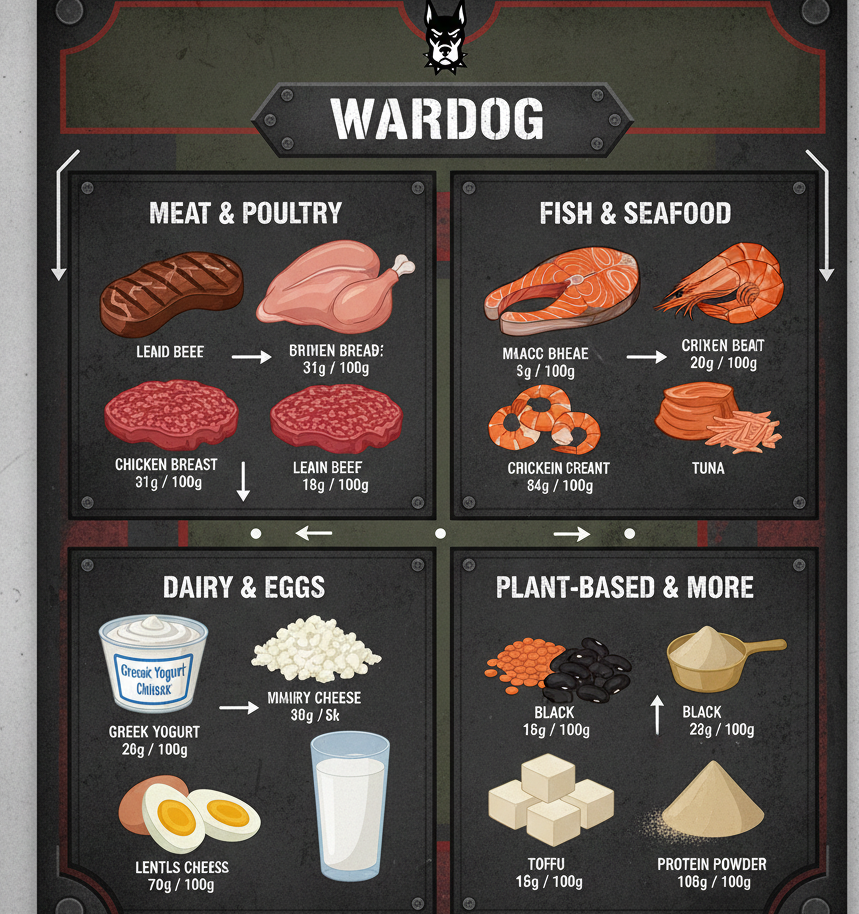
Here’s what hitting 150 grams of protein across four meals might look like:
Breakfast (35g protein):
- 3 whole eggs
- 2 egg whites
- 1 slice whole grain toast
Lunch (40g protein):
- 6 oz grilled chicken breast
- Quinoa and mixed vegetables
- Side salad
Post-Workout Shake (30g protein):
- 1 scoop whey protein powder
- Banana and berries
Dinner (45g protein):
- 8 oz salmon
- Sweet potato
- Steamed broccoli
This distribution provides approximately 25-40 grams per meal, spaced throughout the day for sustained muscle protein synthesis.
When to Consider Protein Supplements
Protein powders and supplements are particularly useful when:
- You need a quick protein source post-workout
- You’re struggling to hit your daily target with whole foods
- You need a convenient on-the-go option
- You want a cost-effective protein source compared to some whole foods
- You’re looking for a low-calorie, high-protein option during fat loss
- You need a quick protein source post-workout
- You’re struggling to hit your daily target with whole foods
- You need a convenient on-the-go option
- You want a cost-effective protein source compared to some whole foods
- You’re looking for a low-calorie, high-protein option during fat loss
WARDOG muscle-building supplements offer high-quality whey protein formulated specifically for serious lifters who demand both purity and results. Unlike many mass-market proteins filled with fillers and artificial additives, WARDOG”s protein powder delivers clean, effective nutrition to support your training.
Track and Adjust
Use a food tracking app or simple journal to monitor your daily protein intake for at least a week or two. This awareness helps you identify patterns and gaps in your nutrition.
More importantly, track your training progress:
- Are you getting stronger?
- Are you adding muscle mass?
- How’s your recovery between workouts?
If progress stalls despite consistent training, adjusting your protein intake (up or down) might be warranted. Nutrition, like training, requires individualization and sometimes experimentation to find what works best for your body.
Wardog: Your Partner in Muscle Building
Building muscle requires more than just showing up to the gym, it demands a comprehensive approach integrating smart training, strategic nutrition, and adequate recovery. We understand this synergy and has built an entire ecosystem to support your muscle-building journey.
Our workout and nutrition guide combines evidence-based training protocols with practical nutrition strategies, taking the guesswork out of your muscle-building plan. Whether you’re a beginner learning the fundamentals or an experienced lifter looking to break through a plateau, our resources provide the roadmap you need.
Looking to optimize your recovery and come back stronger for each session? Check out our WARDOG blog on workout recovery, where we dive deep into the science of rest, adaptation, and maximizing your body’s response to training.
At WARDOG, we’re not just another supplement company making empty promises. We’re lifters, coaches, and nutrition enthusiasts who demand real results backed by real science. That’s why we create products and content designed to actually work, no gimmicks, no misleading claims, just proven strategies for building the strong, muscular physique you’re working toward.
Conclusion
So, how important is protein for building muscle? The answer is simple: absolutely critical.
Protein provides the essential amino acids your body needs to repair damaged muscle fibers and synthesize new muscle tissue. Without adequate protein intake, typically 1.6 to 2.2 grams per kilogram of body weight daily for active lifters, your muscle-building progress will be severely compromised, regardless of how perfectly you structure your training program.
But remember, intelligent protein consumption goes beyond simply hitting a number. The quality of your protein sources, the distribution of intake across multiple meals throughout the day, and strategic timing around training all contribute to maximizing your results. Combine these nutritional strategies with progressive resistance training, and you create the optimal environment for muscle growth.
Avoid falling for myths about protein damaging your kidneys or believing that simply eating more protein automatically equals more muscle. Instead, focus on consistent, adequate intake from high-quality sources, distributed intelligently throughout your day to support ongoing muscle protein synthesis.
The path to building significant muscle is straightforward but not easy. It requires dedication to both training and nutrition, day after day, week after week. The lifters who succeed aren’t necessarily the ones with perfect genetics or unlimited time, they’re the ones who consistently execute the fundamentals, including hitting their protein targets daily.
Ready to Take Action?
Start today by calculating your personal protein target using the formula provided in this guide. Track your intake for the next week to establish your baseline, then make the necessary adjustments to hit your target consistently.
Looking for support on your muscle-building journey? Explore Wardog’s complete line of supplements, training guides, and nutrition resources designed specifically for serious lifters who refuse to settle for mediocre results. Download our free muscle-building checklist to ensure you’re covering all the essential bases for optimal growth.
Your stronger, more muscular future starts with the decisions you make today, and adequate protein intake is non-negotiable. Now get out there, hit your protein targets, train hard, and watch your progress accelerate.